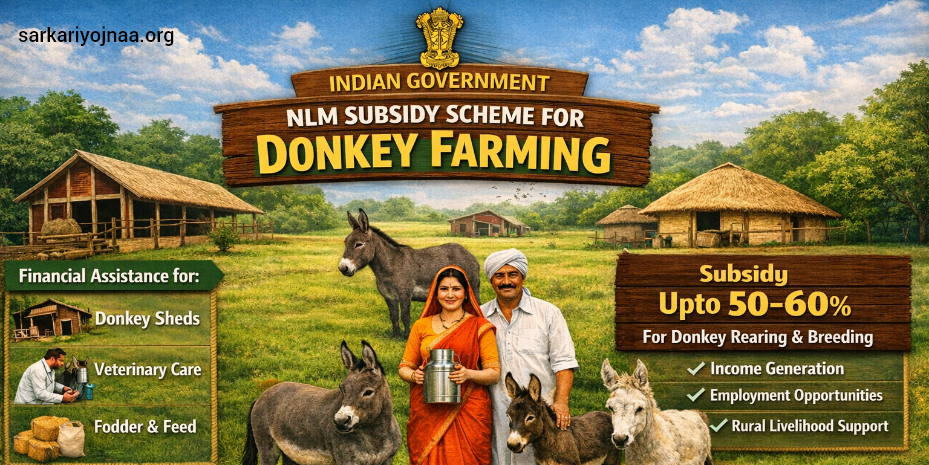
India is witnessing a unique shift in the livestock sector, where unconventional farming ideas like donkey farming are gaining attention. To support this emerging opportunity, the Government of India has introduced financial assistance under the National Livestock Mission (NLM)—a scheme designed to boost entrepreneurship and rural income.
If you’re planning to start a donkey farming business, this guide will help you understand the subsidy, eligibility, benefits, and application process.
What is the National Livestock Mission (NLM)?
The National Livestock Mission (NLM) is a centrally sponsored scheme launched by the Ministry of Fisheries, Animal Husbandry & Dairying. Its main objective is to promote livestock-based entrepreneurship, improve breeds, and increase productivity in sectors like poultry, goat, sheep, piggery, and emerging areas like donkey farming.
The scheme focuses on:
- Employment generation in rural areas
- Breed improvement and conservation
- Strengthening feed and fodder supply
- Supporting livestock-based startups
Donkey Farming Under NLM Scheme
Donkey farming has recently been included under the Entrepreneurship Development Programme (NLM-EDP). The government aims to:
- Reverse the sharp decline in donkey population
- Promote indigenous breeds
- Encourage production of high-value products like donkey milk
India has seen a significant drop in donkey population over the years, which has made this sector a priority for conservation and commercialization.
Details for Donkey Farming
One of the biggest attractions of this scheme is the high subsidy amount:
- Subsidy: 50% of project cost
- Maximum Limit: Up to ₹50 lakh
- Eligible Projects: Donkey breeding farms, dairy units, and related infrastructure
The subsidy is provided under NLM-EDP to individuals, Farmer Producer Organizations (FPOs), Self Help Groups (SHGs), and startups. (Press Information Bureau)
👉 Example:
If your project cost is ₹1 crore, the government can fund up to ₹50 lakh.
Requirements for Donkey Farming Unit
To qualify for maximum subsidy, applicants typically need:
- A structured donkey breeding farm setup
- Minimum livestock size (e.g., around 50 females + 5 males for large units)
- Land and infrastructure for shelter, feeding, and healthcare
- Detailed Project Report (DPR)
The focus is on organized and scalable farming models, not small unstructured setups.
Why Donkey Farming is a Profitable Opportunity
Donkey farming is emerging as a high-potential niche business due to:
1. High Demand for Donkey Milk
Donkey milk is widely used in:
- Cosmetics (anti-aging products)
- Pharmaceuticals
- Nutritional supplements
It is one of the most expensive types of milk in niche markets.
2. Export Potential
Products like donkey milk and hides have growing demand in international markets, especially in Asia.
3. Low Competition
Unlike dairy or poultry, donkey farming is still underdeveloped in India, offering first-mover advantage.
4. Government Support
The NLM subsidy significantly reduces initial investment risk.
Eligibility Criteria
You can apply if you are:
- An individual entrepreneur
- Farmer or livestock owner
- FPO / SHG / Cooperative
- Startup or Section 8 company
Applicants must also:
- Have basic knowledge of livestock farming
- Secure bank loan (for remaining project cost)
- Follow state livestock department guidelines
How to Apply for NLM Donkey Farming Subsidy
Follow these steps:
Step 1: Prepare a Project Report
Create a Detailed Project Report (DPR) including:
- Investment plan
- Number of animals
- Revenue model
Step 2: Apply Online
Register and apply through the official NLM portal:
👉 nlm.udyamimitra.in
Step 3: Bank Loan Approval
Get financial approval for the non-subsidized portion.
Step 4: Government Approval
Your application is reviewed by state and central authorities.
Step 5: Subsidy Disbursement
Subsidy is released in phases based on project progress.
Challenges to Consider
While the opportunity is promising, there are challenges:
- Limited awareness and training
- Market linkage for donkey milk
- Initial high investment
- Need for proper veterinary support
Future Scope of Donkey Farming in India
With increasing demand and government backing, donkey farming can become:
- A high-value agribusiness model
- A startup opportunity in rural India
- A sustainable livestock sector for exports
The NLM scheme is expected to play a key role in transforming this overlooked segment into a profitable industry.
Conclusion
The NLM subsidy scheme for donkey farming is a golden opportunity for farmers and entrepreneurs looking to enter a unique and profitable livestock business. With up to ₹50 lakh in government support, reduced financial risk, and growing market demand, donkey farming is no longer unconventional—it’s the next big opportunity in Indian agriculture.
If you want, I can also:
- Optimize this blog with keywords + meta tags for SEO
- Add FAQs section for ranking
- Create a landing page version for lead generation