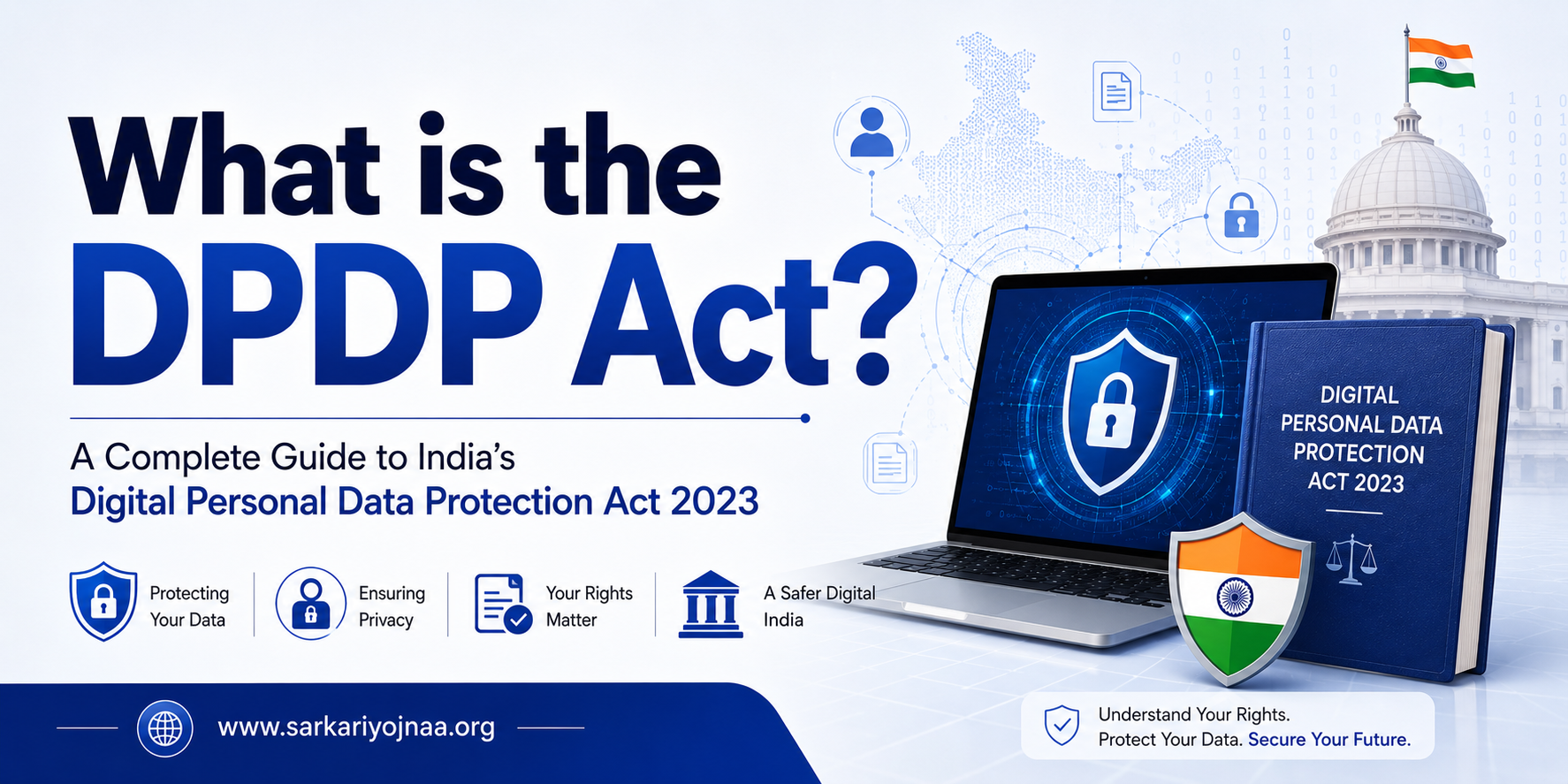
In today’s digital-first world, every click, swipe, and online transaction generates personal data. From shopping apps to social media and government services, our information is constantly being collected and processed. But who protects this data, and how? Enter the Digital Personal Data Protection Act, 2023 (DPDP Act) — India’s first comprehensive national data privacy law. Passed on August 11, 2023, it marks a historic shift in how India governs digital personal data, balancing individual privacy rights with the needs of businesses and government for lawful data use.

If you run a business, work in tech, or simply use digital services in India, understanding the DPDP Act is no longer optional — it’s essential. This detailed guide breaks down everything you need to know: what the Act covers, who it affects, key obligations, individual rights, enforcement mechanisms, and the latest implementation status as of 2026.
Why Was the DPDP Act Needed?
India has long relied on fragmented rules under the Information Technology Act, 2000 (particularly Section 43A and the SPDI Rules, 2011) for data protection. These were narrow, focused mainly on “sensitive personal data,” and lacked a dedicated regulator or strong enforcement.
After years of consultations, multiple draft bills (2018, 2019, and 2022), and parliamentary debates, the DPDP Act was enacted to create a unified, modern framework. It draws inspiration from global laws like the EU’s GDPR but is tailored to India’s context — simpler in some areas, more flexible in others, and focused exclusively on **digital personal data**.
The Act aims to:
– Empower individuals (Data Principals) with control over their data.
– Impose clear responsibilities on organizations (Data Fiduciaries).
– Establish a dedicated Data Protection Board for oversight and enforcement.
– Replace outdated rules and bring India in line with international privacy standards.
Scope and Applicability: Who and What Does It Cover?
The DPDP Act applies to the **processing of digital personal data** — any data about an identifiable individual that is in digital form (or was collected offline and later digitized).
It applies if:
– The data is processed within India.
– The processing is connected to offering goods or services to individuals in India (even if the organization is based outside India — extraterritorial effect).
It does NOT apply to:
– Non-digital (purely offline) personal data.
– Personal or domestic use.
– Data made publicly available by the individual or required by law to be public.
This broad but digital-only scope covers almost every app, website, e-commerce platform, fintech company, healthcare provider, and even government portals that handle Indian residents’ data.
Key Definitions You Must Know
– **Data Principal**: The individual whose personal data is being processed (you and me).
– **Data Fiduciary**: Any person or entity (company, government body, startup) that decides the **purpose and means** of processing the data — essentially the “controller.”
– **Data Processor**: Processes data on behalf of a Data Fiduciary (e.g., cloud providers, analytics firms).
– **Significant Data Fiduciary (SDF)**: Designated by the Central Government based on factors like data volume, sensitivity, impact on rights, or national security. These face extra obligations.
– **Consent Manager**: A registered intermediary that helps Data Principals manage consents in one place.
– **Personal Data Breach**: Any unauthorized or accidental access, disclosure, or loss of data.
Core Principles of Data Processing
The DPDP Act is built on seven foundational privacy principles (explicitly referenced in the law and rules):
1. **Lawful processing** — Only with consent or for specified “legitimate uses.”
2. **Purpose limitation** — Data can only be used for the specified purpose.
3. **Data minimization** — Collect only what is necessary.
4. **Accuracy** — Keep data correct and up-to-date.
5. **Storage limitation** — Erase data once the purpose is served (unless law requires retention).
6. **Security** — Implement reasonable safeguards.
7. **Accountability** — Data Fiduciaries are responsible for compliance.
Consent vs. Legitimate Uses: When Can Data Be Processed?
**Consent** is the primary basis and must be:
– Free, specific, informed, unconditional, and unambiguous (clear affirmative action, e.g., ticking a box — not pre-ticked or silence).
– Given via a clear **notice** explaining what data is collected, the purpose, rights, and how to complain.
– Withdraw able easily at any time (processing stops unless another legal basis applies).
– Verifiable parental/guardian consent for children under 18 or persons with disabilities (plus no tracking or targeted advertising).
**Legitimate Uses** (no consent needed) include:
– Voluntary data sharing (if the principal does not object).
– State functions (subsidies, benefits, services).
– Employment or recruitment.
– Medical emergencies, epidemics, or disasters.
– Legal compliance or court orders.
Rights of Data Principals (Individuals)
The Act gives individuals strong, enforceable rights:
– **Right to access** — Summary of data processed, purposes, and sharing details.
– **Right to correction, completion, updating, or erasure**.
– **Right to grievance redressal** — Every Fiduciary must provide an easy mechanism.
– **Right to nomination** — Nominate someone to exercise rights in case of death or incapacity.
– Right to clear notice and consent withdrawal.
These rights must be exercised easily, and Fiduciaries must respond within prescribed timelines.
Obligations of Data Fiduciaries
Every organization processing data must:
– Issue clear, itemized privacy notices.
– Ensure data security (encryption, access controls, etc.).
– Notify the Data Protection Board and affected individuals in case of a breach (timelines detailed in Rules 2025).
– Erase data when no longer needed.
– Appoint a Data Protection Officer (for SDFs).
– Conduct Data Protection Impact Assessments and audits (for SDFs).
– Maintain records and enable grievance redressal.
Significant Data Fiduciaries face stricter rules: independent audits, algorithmic assessments, and restrictions on certain cross-border transfers of personal/traffic data.
Cross-Border Data Transfers
Unlike the GDPR’s strict adequacy requirements, the DPDP Act follows a **blacklist approach**: Transfers outside India are allowed unless the government notifies specific restricted countries. This makes compliance easier for global businesses while allowing government oversight for sensitive cases.
The Data Protection Board of India (DPB)
The DPB is the independent regulator (established under the Act and operational since November 2025). It:
– Handles complaints and inquiries.
– Investigates breaches.
– Imposes penalties.
– Operates digitally for efficiency.
It does **not** have rule-making powers — those remain with the Central Government.
Penalties and Enforcement
Penalties are significant and tiered (up to ₹250 crore per violation):
– Breach of child data obligations or failure to prevent a breach: Up to ₹200 crore.
– Failure to notify breach: Up to ₹200 crore.
– Other obligations: Up to ₹250 crore (highest tier) or ₹50 crore.
– Data Principal duties: Up to ₹10,000.
The Board considers factors like severity, impact, and mitigation before imposing fines. Appeals go to the Telecom Disputes Settlement and Appellate Tribunal.
Current Implementation Status (March 2026)
The DPDP Rules, 2025 were notified by MeitY on November 13–14, 2025, operationalizing the Act in phases:
– **Phase 1 (Immediate — November 2025)**: Data Protection Board established and operational; definitions and basic powers in force.
– **Phase 2 (November 2026)**: Consent Manager registration and framework.
– **Phase 3 (May 2027 — 18 months from notification)**: Full substantive compliance — notices, consent, rights exercise, breach reporting, security safeguards, SDF obligations, etc.
Businesses currently have **until mid-May 2027** for full operational readiness, but governance structures (policies, DPOs for SDFs, breach protocols) should be built now.
DPDP Act vs. GDPR: Quick Comparison
| Aspect | DPDP Act (India) | GDPR (EU) |
|————————-|——————————————-|—————————————-|
| Scope | Digital personal data only | All personal data |
| Legal basis | Consent OR Legitimate Uses | 6 bases (including legitimate interest)|
| Cross-border transfers | Allowed unless blacklisted | Adequacy, SCCs, or Binding Rules |
| Regulator | Data Protection Board | Multiple DPAs + EDPB |
| Fines | Up to ₹250 crore | Up to €20M or 4% global turnover |
| Rights | Access, correction, erasure, nomination | Broader (portability, objection, etc.) |
The DPDP Act is more business-friendly in some areas (e.g., transfers) but stricter on consent and child data.
Who Needs to Comply and How to Prepare?
– **Everyone** handling Indian users’ digital data — startups, SMEs, MNCs, government bodies.
– **Action steps now**:
1. Map your data flows and processing activities.
2. Update privacy notices and consent mechanisms.
3. Appoint a DPO if you qualify as an SDF.
4. Implement breach response protocols.
5. Review vendor/processor contracts.
6. Train teams and conduct gap assessments.
Conclusion: A New Era of Digital Trust
The DPDP Act is not just another regulation — it’s India’s commitment to digital sovereignty and individual empowerment in the age of AI, big data, and seamless online services. While full enforcement is still phasing in (deadline May 2027), proactive compliance will build customer trust, reduce legal risks, and position organizations for long-term success in India’s booming digital economy.
Whether you’re a business leader, privacy professional, or concerned citizen, staying informed is the first step. Start reviewing your practices today — the clock is ticking.
**Have questions about DPDP compliance for your organization?** Drop them in the comments or reach out for a consultation. Subscribe for more in-depth guides on data privacy, cybersecurity, and India’s evolving digital laws.
*Last updated: March 2026. Always refer to official MeitY notifications and consult legal experts for specific advice.*